What is brand voice? A working definition, with examples
Brand voice is the consistent personality a business uses in everything it writes, from the homepage to an overdue-invoice reminder. Most definitions stop at a list of adjectives. This one goes further, into the decisions that make a voice recognisable.

What is brand voice?
Brand voice is the distinct and consistent way a business expresses itself in words. It is the personality behind the writing: what the business chooses to say, how directly it says it, which words it reaches for and which it avoids, and how it treats the reader.
A useful test is to cover the logo. If a customer could read an email, a product page and a social post with the name removed and still tell they came from the same business, that business has a voice. If the three pieces could belong to any competitor, it has a style guide at best, and more often a set of habits that drift with whoever is writing that week.
Every business already has a voice, whether or not anyone chose it. If nobody has defined it, it is simply the sum of whoever wrote the last ten things, and readers notice the inconsistency even when they couldn't name it. Defining a voice is the act of choosing on purpose.
Voice applies to everything with words in it. Proposals, invoices, error messages, job adverts, the out-of-office reply. Customers meet a business in small moments far more often than in big campaigns, so the small moments carry most of the voice.
What is the difference between brand voice and tone of voice?
People use the two terms interchangeably, which causes confusion. They describe different things.
Voice is the constant. It is who the business is, and it should be recognisable across every piece of writing.
Tone is the adjustment. It changes with the situation and the reader's state of mind, the way a person's tone changes between congratulating a friend and telling them their car has been towed. The person is the same. The delivery shifts.
Take an invented business, Fenwick Bike Repair, whose voice is practical, warm and a little dry. Its tone on a social post about a second workshop opening can be playful. Its tone in an email telling a customer their frame is cracked and unsafe to ride should be calm, plain and serious, with the next step stated first. A joke in that second email would be a tone failure, even though dry humour is part of the voice.
When someone says "our tone of voice", they usually mean the whole package, and that is fine in conversation. When you come to write it down, separating the two helps: define the voice once, then describe how tone moves for different situations and different readers.
Brand voice examples: how different businesses sound
The clearest way to understand voice is to hear the same message delivered by different personalities. Here are four invented businesses, each telling customers that delivery has gone from three working days to five.
Coldharbour Coffee Roasters has a voice built on craft and curiosity. It explains the reason in some detail, because its customers enjoy knowing how things work: a new green-bean supplier, a longer resting period after roasting, what that does to the flavour in the cup. Sentences are relaxed, the vocabulary is specific, and it trusts the reader to care.
Marsh & Pell Solicitors writes with authority and restraint. It states the change in the first line, gives the new timescale, and offers a direct contact for anyone with an urgent matter. No explanation of internal causes, no warmth for its own sake. Its readers want certainty, and the voice gives it to them.
Little Wren Toys is playful and writes parent to parent. It admits the delay, owns it, and makes a small joke at its own expense. The message is short, and it ends by telling parents what to do if a birthday is coming up.
Tallis Industrial Supply is plain and practical. Three lines: what changed, the new lead time, the part numbers that are still next-day. Its customers are buyers working down a list, and anything extra slows them down.
Each of these is right for its own business and readers, and would be wrong for the other three. Look at what separates them: how much they explain, what comes first, how much personality shows on the surface, and what they assume about the reader. Those are the working parts of a voice.
Why adjectives don't define a voice
Most brand guidelines describe voice with three or four adjectives. Friendly, professional, approachable, confident. Almost every business would sign up to those words, so they separate you from nobody.
Adjectives also fail as instructions. Ask five writers to be "friendly" and you will get five different results. One adds exclamation marks, another uses first names, a third writes longer sentences full of reassurance, and somebody tells a joke. Each has followed the guideline. The output still sounds like five businesses.
The fix is to translate each adjective into behaviour you can see on the page. "Friendly" might become: we use the reader's first name, we write "we" and "you", we never use the passive voice to dodge responsibility, and we answer the question before we explain the policy. Now a writer, or an AI tool, has something to follow, and an editor has something to check against.
A good test for any voice rule: could a stranger look at a paragraph and say whether it follows the rule or breaks it? If they couldn't, the rule is a mood.
What is a brand voice made of?
If adjectives are the summary, these are the parts underneath.
- Personality. The character the business plays. Many teams use brand archetypes for this, such as the Sage, the Caregiver or the Jester, because an archetype carries a whole set of instincts about what a brand values and how it speaks.
- Point of view. What the business believes about its field and is willing to say out loud. A voice with no opinions fills space with generalities.
- Vocabulary. Words you use, words you avoid, and how much jargon your readers will tolerate. An electrical wholesaler can say "RCBO" to electricians and lose a homeowner with the same word.
- Rhythm and structure. Sentence length, how quickly you get to the point, whether you lead with the answer or the context.
- Stance towards the reader. Expert to novice, peer to peer, or a steady hand for someone anxious.
The last one is easy to skip, and it is where most voices quietly go wrong. Voice is always relative to a reader. A solicitor's firm may need to sound slightly different to a first-time buyer and to a commercial property developer while staying recognisably itself. That is tone adjusting to an audience, and it only works if you know who your audiences are and what each of them needs from you.
Why brand voice matters more once AI is writing
For years a loose voice survived because one or two people did most of the writing and carried it in their heads. That stops working as more people write, and it breaks completely when AI produces the first draft.
A language model given no voice writes towards the middle: competent, polite, and interchangeable with every other business that asked the same question. It cannot read a set of adjectives and infer your decisions about structure, vocabulary and stance, any more than a new freelancer could. It needs the decisions spelled out, and it needs to know who it is writing for.
That is the problem BraVo was built around. A BraVo profile holds your business, your brand (archetype blend, voice and tone, mission, values) and up to three audiences, each modelled separately, and every piece is generated through those layers. The voice is there from the first word, and you edit from there.
Whichever way you write, the next step is the same. Take your brand's adjectives and, for each one, write two sentences describing what it looks like on the page. Where you can't, you have found the gap.

How to define your brand voice: a practical method with a worked example
A five-step method for defining your brand voice, from purpose and archetype to rules you can test, with a worked example for a small business.
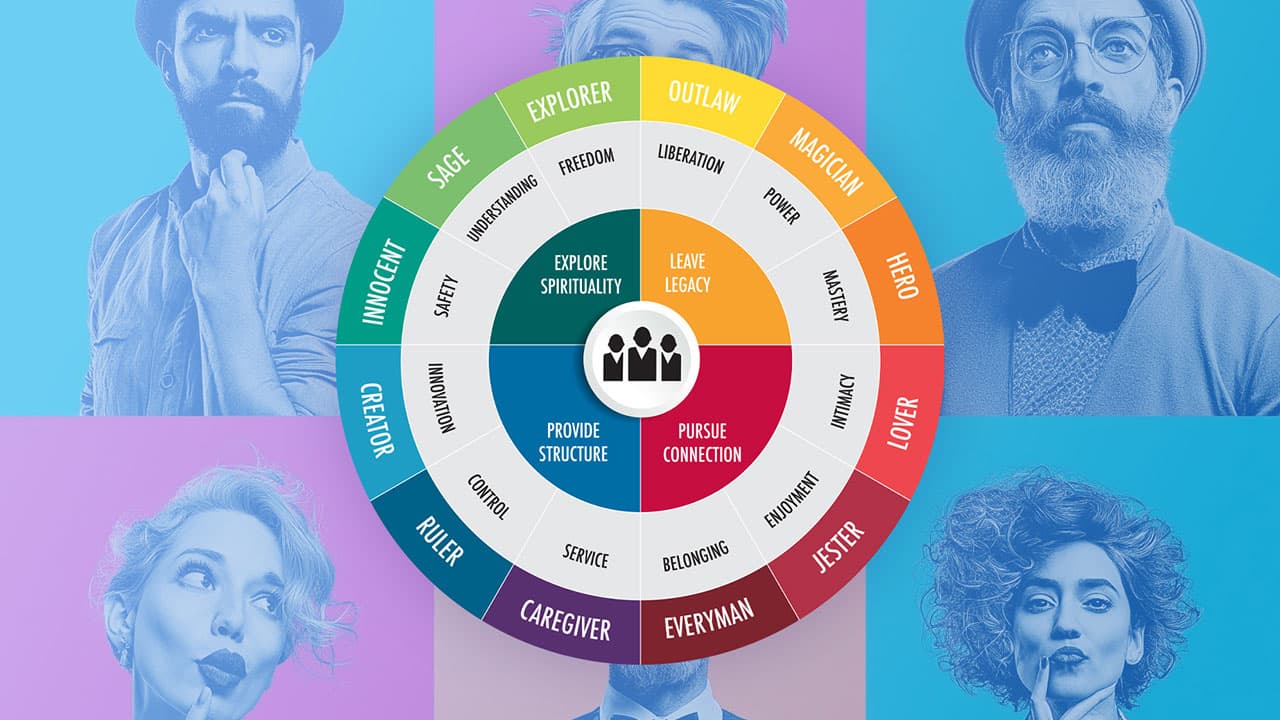
The twelve brand archetypes, and how to choose yours
Archetypes are the most useful branding model in common use, and the most commonly misapplied. Here is what each one actually does to your writing.
Give your voice somewhere to live
BraVo holds your brand voice and audiences in one profile and applies them to every piece it generates, across ten publishing channels.